
Help buyers find your business in AI answers.
I review your website, competitors and content to find what’s missing. Then I improve the content and technical foundations, and track whether your business gets mentioned or linked in AI answers.
What I check when your competitors appear in AI answers
I look at the whole picture: your website, your competitors and the pages appearing in those answers.
I check for missing content, whether your existing pages cover the topic in enough depth, on-page elements such as titles and metadata, and technical issues. I also look at your website’s authority, topical authority and how thoroughly your content covers the services or subjects you want to be found for.
Testing the questions buyers ask
I start with the questions a buyer would ask about your services and test those prompts myself.
I follow the buyer’s journey, looking at the related searches and follow-up questions around each main prompt. This helps me see what information buyers need and where your content has gaps.
I do my own testing because I haven’t found a tool accurate enough to rely on by itself. I ask follow-up questions to understand what information the AI is using to answer, then inspect the sources it shows.
Adding the content that’s missing
If there’s already a relevant page, I add more depth to its content. If the topic isn’t covered, I create a new page that explores it thoroughly. That can mean 2,000 words or more, depending on what the topic needs.
I build that detail by reviewing competing pages, interviewing the client and doing my own research using AI. I ask the client to review the content for accuracy. I also cross-check it using multiple AI tools.
If you’re not showing up for searches related to your services or products, I look at whether your content answers what buyers are asking.
That might be someone looking for the best gutter installer in their area or a particular style of black Italian leather shoe. I create or improve content around those questions and make sure Google and relevant AI search crawlers can access and read it.
AI SEO pricing and timeframes
AI-search work and tracking are included in my SEO service, starting from $1,500 per month including GST. The price can be higher depending on how many prompts you want tracked.
The timeframe depends on your website and how much SEO work is already in place. An established site with previous SEO work may start seeing changes within a few weeks. A new website may take up to 12 months. These are estimates, rather than guaranteed timelines.
My own website as an example
I’ve seen my own website appear multiple times in Google’s AI Overview for “AI audit Melbourne”. My view is that the original content and first-hand experience on the site help it stand out.
AI SEO Consulting for Melbourne Businesses
Are you looking to rank in LLMs like Gemini or ChatGPT or just looking to show up in an AI overview for a search query?
We can help you show in AI searches across multiple platforms.
The landscape of traditional SEO is shifting; we are moving from the traditional 10 blue links in SERPs to the new way of searching via LLMs. Brands are now struggling to get traction in search results since the launch of AI overviews in Google Australia. Traffic figures are in a decline for brands that are not actively trying to rank in AI overviews.
Tracking: How do you track AI traffic or Impressions?
Google includes AI Overviews and AI Mode in Search Console’s overall Web performance reporting. It does not provide the separate impressions-only generative AI report previously described here. See Google’s guidance on AI features and Search Console reporting.
I repeat the same prompts each week across the AI platforms I test. I use tools I’ve created to run the searches and record whether your business is mentioned, whether your website is linked and which competitors appear.
That gives us a record to compare how visibility changes over time. The reporting depends on the agreed scope and budget. If competitor tracking is included, I use tools such as Semrush or Ahrefs alongside my own testing.
Are you down in traffic and leads? You are not alone
Last month, a long-term client sent me a panic email in the middle of the day. I’ve worked with them for five years, and they are truly one of the best. the kind of people who know how to scale a business and turn every call into revenue. When we started together, they had a one-page Wix website with almost no SEO, and predictably, they weren’t getting any leads.
We began by building them a new site, and within six months, they were generating enough leads to see a significant return. However, the recent panic was because their phone had stopped ringing. They had gone from averaging one conversion per day to just one a week or sometimes one every two weeks.
I did a full SEO audit of the website, as I do every month. Their rankings were steady, even slightly better than the previous month, but one metric stood out: organic traffic had plummeted by 40%. For a business with staff to pay and families to feed, that hit to revenue was devastating. The website was even ranking for local searches.
After spending days investigating technical issues, I concluded that nothing was “wrong” with the website. The content was human-produced, there were no technical errors, and the domain authority remained strong.
So, what changed?
Google was now displaying AI Overviews for the informational “question” queries where we were still ranking #1. Even though we held the top spot, we weren’t getting the clicks. Click-through rates on these queries dropped to 10% because Google was answering the questions directly on the search page. Without a reason for the user to “hook” into the site, they simply read the AI summary and moved on to the next sponsored ad to do business.
While commercial keywords without AI overviews were still performing well, the blog posts and high-value guides were being cannibalized.
From that point on, I had to pivot my SEO methodology. I didn’t have to throw everything away, but I did have to reinvent the wheel. I’ve shifted the focus toward building a brand that remains visible and authoritative within these AI Overviews.
Whether you call it AEO, GEO, or AIEO, I call it the “New SEO.” The fundamentals are there, but the focus has shifted: it’s now about building a brand that Google’s AI feels compelled to cite.
What has changed since the introduction of AI in search?
You might have heard about these new abbreviations on the market, like AI SEO, AEO, GEO, Gemini SEO, ChatGPT SEO, and so many more. The truth of the matter is they are all just a part of SEO. If you have been doing SEO for some time, you would have seen the same hype when voice search started. All the SEO agencies and SEO consultants like me started selling these services. In reality, all these are a part of traditional SEO.
You might have seen companies claiming they know the secret to AI SEO; if you ask them what it is, most of them won’t reveal a thing, saying that it’s their IP. But some who do spill the beans will say things like structured data, backlinks, ease of crawlability, and indexability. None of these are new; they have always been part of SEO optimisation since the inception of SEO.
My prediction for the market is Google will eventually let go of the blue links, and the default searches would be in AI mode, and you would need to click to see organic blue links. Google is already testing this with AI MODE buttons on the search page and sometimes showing full-page AI overviews to users on mobile.
Google has so many spam updates this year to tackle issues like Reddit SEO spam and so on. There is no black hat way to rank in search; if someone sells you a quick way, they are just making you vulnerable to future Google updates which may cost you more in the long run.

How to get your website picked up by AI?
SEO for AI Overviews and LLMs like ChatGPT prioritise high-quality, trustworthy content that directly answers user questions. They favour content from authoritative sources that demonstrate expertise and reliability (E-E-A-T). Content needs to be well-structured with clear headings, lists, and short paragraphs. This makes it easy for AI to understand the webpage.
Helping it to extract required information from content. Using structured data, also known as schema markup, can also help both systems understand the content or page topic. Technical SEO fundamentals like crawlability also matter, because if an AI bot can’t reach your website easily, it’s less likely to show in the top searches.
Please beware of agencies selling special markdown files or CDN edge scenarios where they serve a schema-rich or TXT page to the LLM bot. All of these things are snake oil, and companies are making good money selling these. In general there is nothing special you need to do for AI. All you need to do is do good SEO and you will rank in all LLMs and so on. All of these things are present on Google documentation for SEO and are said on live stages by Google’s search engineers like John Muller.
What Is GEO And Why It's Different?
So, what is this new GEO, AEO, or LLMO, you may ask? In short, it’s still SEO. If anyone tells you otherwise, they haven’t been in this space long enough. SEO veterans have been saying since day one: this is SEO, and it will always be SEO.
Every year, Google introduces something new. People come up with “hacks” to rank higher, but eventually, Google catches up, and those so-called SEO “ninjas” find their sites de-indexed or pushed beyond page 10.
Now, agencies are selling a “new” service: GEO (Generative Engine Optimization) or AEO (Answer Engine Optimization). To answer the question of how this differs from traditional SEO—it’s simple. It’s the same thing, just with wings.
You still need to practice solid SEO fundamentals, but now you must also track how your brand performs in “AI Mode” and AI Overviews. Whether it’s Google Search, Gemini, or ChatGPT, the goal remains the same: staying at the top of the results.
What is LLM SEO?
LLM SEO stands for Large Language Model Search Engine Optimisation. You need to make it super easy for AI tools like ChatGPT to understand the content and use this content when they create answers for people.
Regular SEO helps your website show up in traditional search results, but LLM SEO focuses on getting your brand or content directly into these AI-generated answers, even if someone doesn’t click a link.
How do LLMs like ChatGPT and Gemini "read" my website content?
LLMs don’t understand content on website like us humans. LLMs break down your text into small pieces called “tokens”. Then turn them into numbers. Then, they use a special “attention mechanism” to figure out which words are most important. And how these words relate to each other. This helps them understand the meaning and context of your content.
AI needs your content. Every minute, AI models are scraping thousands of websites, and you want your site to be one of them. The goal is to ensure your content shows up in AI-generated searches, ideally with a link back to your website that leads to a click—and potentially a conversion.
Just as Googlebot has done for years, AI bots visit your website. If your site is accessible, the bot downloads the data and retrieves the context of your content along with your brand information. It behaves much like a traditional crawler: it looks for internal links in your menus and throughout your pages, following them until it has scraped data from your entire site.
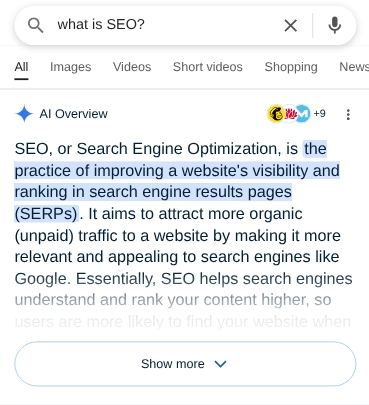
What are Google AI Overviews?
Google AI Overviews are short summaries that appear at the very top of Google search results. They use artificial intelligence to quickly answer your questions by pulling information from many different websites. They includes the website links to the original sources where the information was fetched from.
Why are AI Overviews important for my website?
AI Overviews are changing how people search. The AI only gets about 1% of the total traffi to website as of today, but things are evolving. As per the latest research and information provided by Google in a latest Live event; users are less likely to click on you but if they do click the conversion rate is very high.